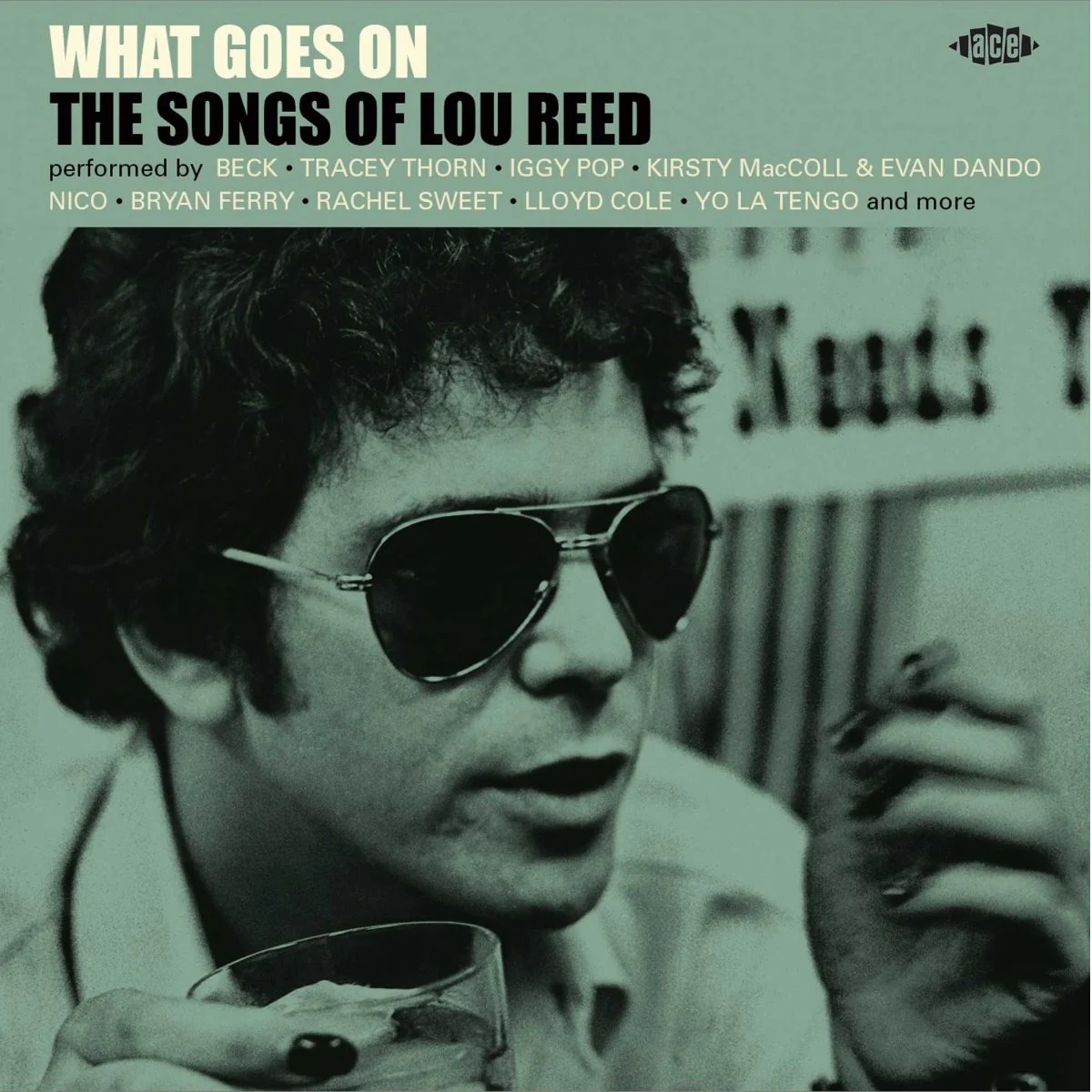
What Goes On - The Songs Of Lou Reed
The latest in Ace Records’ Songwriters series takes the listener from a version of ‘Why Don’t You Smile Now’ from Lou Reed’s pre-Velvet Underground days through selections from the band’s albums to three from 1972’s solo “Transformer”. Here’s Kris Needs – author of a 7,000-word essay in the accompanying 24-page booklet – with some background on the two songs that bookend the collection:
When Lou Reed died in October 2013, music lost an inestimably influential, irascible dynamo, and New York City a towering presence in its artistic skyline. Fearlessly mating his literary grounding and hit factory beginnings with avant-garde assault and gritty narratives on New York’s underbelly in the Velvet Underground, Lou corrupted rock’n’roll and dragged it into modern times with his literate lowlife anthems, redefining the electric guitar as he went along.
Rarely for the times he came up in, such was the strength of his mission and manifesto that cover versions were never on his agenda once the first Velvet Underground songs were worked up. His personality, subject matter and voice itself were so idiosyncratically individual that being covered could present a dauntingly perilous challenge to someone who dared go there. Yet his pre-Velvets career included knocking out cash-in pop songs that were often thinly veiled cover versions, so the ethos was always in his blood. As he told Rolling Stone’s David Fricke about the first Velvet Underground album, “Anyone should be able to play these songs. That’s what I like about them.” That’s the premise that should be remembered when considering the songs reinterpreted by the diverse array of singers and bands corralled on this set, who pull it off by tapping into their essence and giving them their own artistic stamp.
Lou’s songs mirrored New York City’s musical traditions such as doo wop and revolutionary aspects of its cultural evolution, including poetry, jazz and avant-garde experimentation – sometimes all in the same song! Bert Jansch’s ‘Needle Of Death’ notwithstanding, drugs were rarely mentioned on record and, by 1966, it was usually acid or marijuana. Lou’s “Up to Lexington and 125, feel sick and dirty, more dead than alive” marks the first time heroin withdrawal had been so graphically depicted in a rock song. He had actually been to the location in question when heroin invaded his drug menu at Syracuse University, where he wrote the first incarnation of ‘I’m Waiting For The Man’. The sweaty jitters of copping in the danger zone is perfectly captured by John Cale’s pummelling piano, Lou’s relentless rhythm guitar, Sterling Morrison’s snarling guitar curls and Maureen Tucker’s unyielding heartbeat pulse coalescing into one juddering backdrop.
Idiosyncratic US alt-rocker Beck loved the song enough to record his own version twice, starting with his Record Club venture launched in 2009 to cover a whole classic album in one day using fluid line-ups., In July 2010, he and friends tackled “Songs Of Leonard Cohen”, Skip Spence’s “Oar”, INXS’s “Kick”, Yanni’s “Yanni Live At The Acropolis” and “The Velvet Underground & Nico”, posting video footage on his website, disparate collaborators including Radiohead producer Nigel Godrich, TV actor Giovanni Ribisi and Anglo-Icelandic band Fields’ singer-keyboardist Thorunn Magnusdottir. In December 2017, when Beck was in New York to appear on The Tonight Show and play a couple of corporate functions, he used a day off to go into Electric Lady Studios and record this more conventionally nuanced rendition with his live band, his first version’s dissonant junkie clamour replaced by emphasising its status as a classic rock song. The following day, he performed the song at a lucrative private Hilton Hotel bash, then again in 2018 as part of a medley at Madison Square Garden, effectively trailering its online release.
Lou quit the Velvet Underground after the final show of the band’s nine-week residency at Max’s Kansas City in August 1970, before their “Loaded” album was released, citing his snake-like manager and disgust over the editing and mix as he repaired to his parents’ house in Freeport. Exhausted by touring, disillusioned at the band’s lack of success, withdrawing from drugs and intending to devote himself to writing, he took a low-paid typing post at his father’s accountancy firm and started contributing to small press publications. “I’m a poet,” he declared after a successful reading at St Mark’s Church Poetry Project, mixing song lyrics and new poems in front of an enthusiastic crowd including Allen Ginsberg and various Warhol associates.
In 2018, the Lou Reed Archive published these poems in a book called Do Angels Need Haircuts?. Uncannily prescient for modern times, ‘We Are The People’ was set to music by Iggy Pop on his 2019 late-life masterpiece “Free”, his rich, mahogany tones reciting lines including, “We are the people without land. We are the people without tradition. We are the people who have known only lies and desperation. We are the people without a country, a voice or a mirror”. The track is one of three beat-less spoken word tone poems that close this startlingly seductive set created with US trumpeter-composer Leron Thomas and guitarist-artist Sarah Lipstate (aka Noveller), its impact continued on ‘Do Not Go Gentle In To The Good’ and ‘The Dawn’. Speaking in a Sirius XM interview, Iggy remembered receiving Do Angel’s Need Haircuts? in the mail: “I opened up the book and it was the first poem on the first page. I thought about what he was saying, and I thought it was today in Trump’s America. Lou was a hero to me. The guy was someone I looked up to and admired because of his skill as a songwriter and what he was able to put across as a lyricist – two separate things. It’s absolutely relevant today. We are the people without land. The poem is a statement. Lou Reed’s statement.”
Tracklist
- I’M WAITING FOR THE MAN – Beck
- WHAT GOES ON – Bryan Ferry
- VICIOUS – Lloyd Cole
- PERFECT DAY – KIRSTY MacColl & Evan Dando
- WRAP YOUR TROUBLES IN DREAMS – Nico
- NEW AGE – Rachel Sweet
- I’LL BE YOUR MIRROR – The Primitives
- RUN, RUN, RUN – Echo & The Bunnymen
- TRAIN ’ROUND THE BEND – The Soft Boys
- PALE BLUE EYES – Alejandro Escovedo
- ALL TOMORROW’S PARTIES – June Tabor & Oysterband
- WHY DON’T YOU SMILE NOW – The Delmonas
- SWEET JANE – Cowboy Junkies
- JESUS – Swervedriver
- FEMME FATALE – Tracey Thorn
- I’M SET FREE – Yo La Tengo
- SUNDAY MORNING – Matthew Sweet & Susanna Hoffs
- ROCK ’N ROLL – Detroit featuring Mitch Ryder
- WALK ON THE WILD SIDE – The Dynamics
- WE ARE THE PEOPLE – Iggy Pop
Soundwave
https://youtu.be/zOnYGdGgqs4
Original: $27.18
-65%$27.18
$9.51Product Information
Product Information
Shipping & Returns
Shipping & Returns
Description
The latest in Ace Records’ Songwriters series takes the listener from a version of ‘Why Don’t You Smile Now’ from Lou Reed’s pre-Velvet Underground days through selections from the band’s albums to three from 1972’s solo “Transformer”. Here’s Kris Needs – author of a 7,000-word essay in the accompanying 24-page booklet – with some background on the two songs that bookend the collection:
When Lou Reed died in October 2013, music lost an inestimably influential, irascible dynamo, and New York City a towering presence in its artistic skyline. Fearlessly mating his literary grounding and hit factory beginnings with avant-garde assault and gritty narratives on New York’s underbelly in the Velvet Underground, Lou corrupted rock’n’roll and dragged it into modern times with his literate lowlife anthems, redefining the electric guitar as he went along.
Rarely for the times he came up in, such was the strength of his mission and manifesto that cover versions were never on his agenda once the first Velvet Underground songs were worked up. His personality, subject matter and voice itself were so idiosyncratically individual that being covered could present a dauntingly perilous challenge to someone who dared go there. Yet his pre-Velvets career included knocking out cash-in pop songs that were often thinly veiled cover versions, so the ethos was always in his blood. As he told Rolling Stone’s David Fricke about the first Velvet Underground album, “Anyone should be able to play these songs. That’s what I like about them.” That’s the premise that should be remembered when considering the songs reinterpreted by the diverse array of singers and bands corralled on this set, who pull it off by tapping into their essence and giving them their own artistic stamp.
Lou’s songs mirrored New York City’s musical traditions such as doo wop and revolutionary aspects of its cultural evolution, including poetry, jazz and avant-garde experimentation – sometimes all in the same song! Bert Jansch’s ‘Needle Of Death’ notwithstanding, drugs were rarely mentioned on record and, by 1966, it was usually acid or marijuana. Lou’s “Up to Lexington and 125, feel sick and dirty, more dead than alive” marks the first time heroin withdrawal had been so graphically depicted in a rock song. He had actually been to the location in question when heroin invaded his drug menu at Syracuse University, where he wrote the first incarnation of ‘I’m Waiting For The Man’. The sweaty jitters of copping in the danger zone is perfectly captured by John Cale’s pummelling piano, Lou’s relentless rhythm guitar, Sterling Morrison’s snarling guitar curls and Maureen Tucker’s unyielding heartbeat pulse coalescing into one juddering backdrop.
Idiosyncratic US alt-rocker Beck loved the song enough to record his own version twice, starting with his Record Club venture launched in 2009 to cover a whole classic album in one day using fluid line-ups., In July 2010, he and friends tackled “Songs Of Leonard Cohen”, Skip Spence’s “Oar”, INXS’s “Kick”, Yanni’s “Yanni Live At The Acropolis” and “The Velvet Underground & Nico”, posting video footage on his website, disparate collaborators including Radiohead producer Nigel Godrich, TV actor Giovanni Ribisi and Anglo-Icelandic band Fields’ singer-keyboardist Thorunn Magnusdottir. In December 2017, when Beck was in New York to appear on The Tonight Show and play a couple of corporate functions, he used a day off to go into Electric Lady Studios and record this more conventionally nuanced rendition with his live band, his first version’s dissonant junkie clamour replaced by emphasising its status as a classic rock song. The following day, he performed the song at a lucrative private Hilton Hotel bash, then again in 2018 as part of a medley at Madison Square Garden, effectively trailering its online release.
Lou quit the Velvet Underground after the final show of the band’s nine-week residency at Max’s Kansas City in August 1970, before their “Loaded” album was released, citing his snake-like manager and disgust over the editing and mix as he repaired to his parents’ house in Freeport. Exhausted by touring, disillusioned at the band’s lack of success, withdrawing from drugs and intending to devote himself to writing, he took a low-paid typing post at his father’s accountancy firm and started contributing to small press publications. “I’m a poet,” he declared after a successful reading at St Mark’s Church Poetry Project, mixing song lyrics and new poems in front of an enthusiastic crowd including Allen Ginsberg and various Warhol associates.
In 2018, the Lou Reed Archive published these poems in a book called Do Angels Need Haircuts?. Uncannily prescient for modern times, ‘We Are The People’ was set to music by Iggy Pop on his 2019 late-life masterpiece “Free”, his rich, mahogany tones reciting lines including, “We are the people without land. We are the people without tradition. We are the people who have known only lies and desperation. We are the people without a country, a voice or a mirror”. The track is one of three beat-less spoken word tone poems that close this startlingly seductive set created with US trumpeter-composer Leron Thomas and guitarist-artist Sarah Lipstate (aka Noveller), its impact continued on ‘Do Not Go Gentle In To The Good’ and ‘The Dawn’. Speaking in a Sirius XM interview, Iggy remembered receiving Do Angel’s Need Haircuts? in the mail: “I opened up the book and it was the first poem on the first page. I thought about what he was saying, and I thought it was today in Trump’s America. Lou was a hero to me. The guy was someone I looked up to and admired because of his skill as a songwriter and what he was able to put across as a lyricist – two separate things. It’s absolutely relevant today. We are the people without land. The poem is a statement. Lou Reed’s statement.”
Tracklist
- I’M WAITING FOR THE MAN – Beck
- WHAT GOES ON – Bryan Ferry
- VICIOUS – Lloyd Cole
- PERFECT DAY – KIRSTY MacColl & Evan Dando
- WRAP YOUR TROUBLES IN DREAMS – Nico
- NEW AGE – Rachel Sweet
- I’LL BE YOUR MIRROR – The Primitives
- RUN, RUN, RUN – Echo & The Bunnymen
- TRAIN ’ROUND THE BEND – The Soft Boys
- PALE BLUE EYES – Alejandro Escovedo
- ALL TOMORROW’S PARTIES – June Tabor & Oysterband
- WHY DON’T YOU SMILE NOW – The Delmonas
- SWEET JANE – Cowboy Junkies
- JESUS – Swervedriver
- FEMME FATALE – Tracey Thorn
- I’M SET FREE – Yo La Tengo
- SUNDAY MORNING – Matthew Sweet & Susanna Hoffs
- ROCK ’N ROLL – Detroit featuring Mitch Ryder
- WALK ON THE WILD SIDE – The Dynamics
- WE ARE THE PEOPLE – Iggy Pop
Soundwave
https://youtu.be/zOnYGdGgqs4